One life insurance journey the whole team could argue from
I mapped the whole life insurance application journey for clients, financial advisors, and fulfillment staff, with survey data, quotes, and video in the map, so roadmap arguments ran on the research.
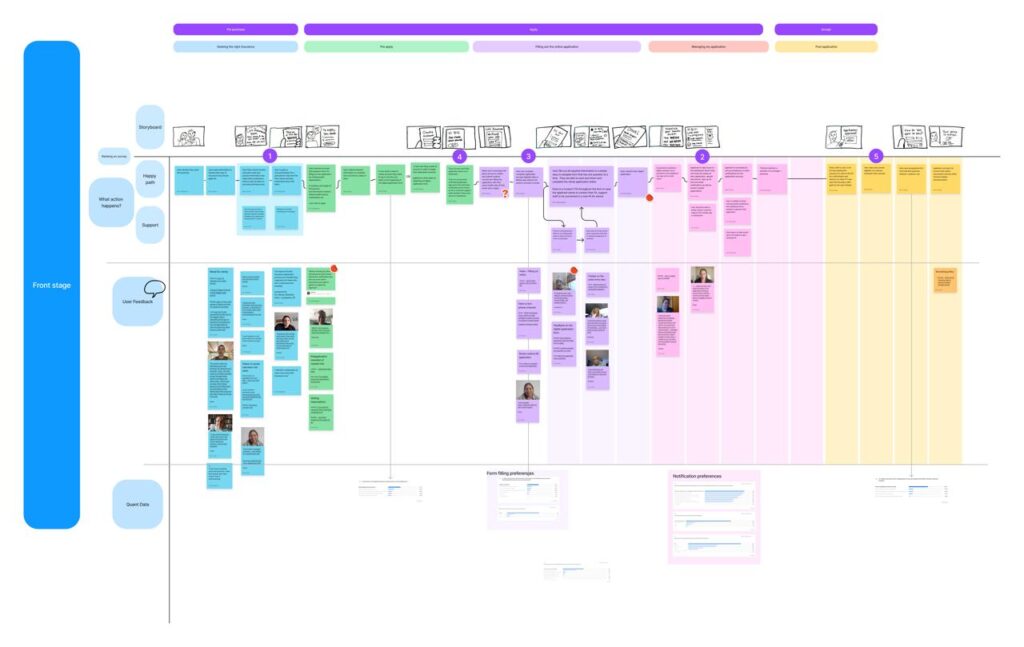
The biggest pain point for every role was waiting, usually for a message that never came.
Present as slides →The problem
Thrivent was modernizing a largely manual life insurance application: stacked paperwork, in-person signatures, notary appointments. Digital tools were fragmented, and nobody had seen the whole journey across the client, the financial advisor and the fulfillment staff who process the application.
The product team owned the digital experience, but Operations and Legal each held pieces of the process, and Legal could stop a roadmap item outright.
My role and the team
I was the Senior UX Researcher for the portfolio. Thrivent ran one researcher per portfolio, and a portfolio usually had two product teams.
On this product I worked with a PM focused on strategy and a PO focused on operations (Thrivent split the traditional PM role in two), three designers and an engineering manager. People from Operations and Legal joined as needed rather than as standing members of the team.
The approach
I started the way I do on every new team, by getting the team’s questions out of their heads, then built from qualitative depth to measurement.
Questions first. A FigJam session with the team to write down what we knew, what we didn’t and what we were assuming, clustered into priority questions. That way the research answered the questions the team actually had, and the assumptions were on the table to test.
In-depth interviews, in rounds of 10. I interviewed people who had bought life insurance online in the previous six months, about the whole journey from deciding to buy through approval. I ran several rounds, to build a rich qualitative base before measuring anything.
Surveys of 100 to 250 people. To measure how common each pain point was and answer stakeholder skepticism, plus feature prioritization to scope the opportunity space. The largest, in May 2022, asked 175 people who had bought life insurance in the previous six months how they applied, which channels they used, how they wanted to share medical information, and how long they expected the process to take. I drafted its questions on the same board as the team’s research questions, so the survey answered them directly.
Follow-up interviews and usability tests on the prototypes the designers put forward.
The journey map carried survey data, verbatim quotes and video clips, and contrasted the current state with the target state.
Constraints. Legal could veto changes, and reaching customers was hard. The company’s existing customer panel, run by a marketing insights team, screened for people 35 and over, while the CEO had told the company it was going after younger customers. Many people start their relationship with a financial institution before 35, so the panel’s personas left a blind spot right where the strategy was aimed.
What we learned
Internal assumptions underestimated how much customers wanted digital self-service.
- People with an existing financial relationship decided far earlier than anyone assumed.
- Clients, advisors and fulfillment staff shared one pain point: waiting, usually for a message that never arrived.
- Customers wanted proactive updates in the channel they chose (text, email or app), not calls from unknown numbers.
The survey sized it. Most buyers started their application on a computer and finished it there, even though most switched channels along the way. Most wanted to complete the application themselves with a professional available if they needed one. More than half had applied without an advisor’s help, even though most had access to one. Their spouse or partner was the strongest influence on the decision. And the process took longer than buyers expected.
What changed
The map gave the team one picture to argue from, so arguments were with the customer instead of with me.
I recommended a digital channel where people could apply, share medical information and buy on their own, with an advisor a click away, without changing the experience for people who prefer an advisor to lead. Setting clear expectations about timing was the other recommendation.
The work shaped the digital self-service strategy, including notification preferences, proactive status updates and channel choice, and my PM used it to reframe roadmap discussions around research-backed priorities.
Looking back
The team tended to pick low-risk places to start, like one flow that only about 200 people a year applied through, where little could go wrong. I’d push harder, earlier, to start where the most users feel the pain.